


Redefining Play-to-Earn at Radiant
The traditional play-to-earn as web3 product model has often been focused purely on financial incentives, sometimes at the cost of gameplay quality. At Radiant, we set out to redefine this approach by integrating meaningful rewards into the core gaming experience. Instead of simply rewarding players for participation, our system ensures that earned rewards contribute to the core game loop, enhancing engagement and progression. This design makes playing feel more rewarding, not just from a financial standpoint but also in terms of game immersion, social interactions, and personal progression.
Collaborating with game industry creatives
A major highlight of this journey was working alongside a creative director from Riot Games, gaining insights from one of the industry's top gaming companies. This experience pushed our team to deliver high-quality designs and product iterations within tight deadlines. Balancing speed, innovation, and execution was a challenge, but it allowed us to refine our approach to building a next-generation gamified platform. Through this process, we shaped Radiant into a space where players not only earn but truly enjoy their gaming journey.
➡️ Case Study: Designing Radiant – A Quest-Driven Gaming & Merch Platform
One of the biggest challenges in designing Radiant was making it feel less like an app and more like an immersive experience. Most apps follow standard UX patterns—clean, functional, predictable. But Radiant isn't just a platform; it's an IP with its own story and world, and we wanted that to be felt at every touchpoint. Instead of a rigid, UI-heavy experience, we leaned into visual storytelling, dynamic interfaces, and narrative-driven UX.
This meant breaking away from typical layouts and thinking more like game designers than app designers. How do we make navigation feel like progression? How do we embed lore into UI elements? How do we create an experience that feels alive rather than static? We experimented with interactive elements, rich visuals, and layered storytelling to ensure Radiant's world wasn't just something users read about—it was something they felt while using the platform. Balancing this with usability was a challenge, but it pushed us to rethink what a product experience could be beyond just screens and buttons.
As the Product Design Lead for Radiant, I was responsible for:
- ✅ Conducting JTBD analysis to understand user motivations.
- ✅ Shaping user stories & acceptance criteria for seamless interactions.
- ✅ Managing global team and the design timeline and cross-functional collaboration.
- ✅ Leading UX/UI design reviews while staying hands-on in execution.

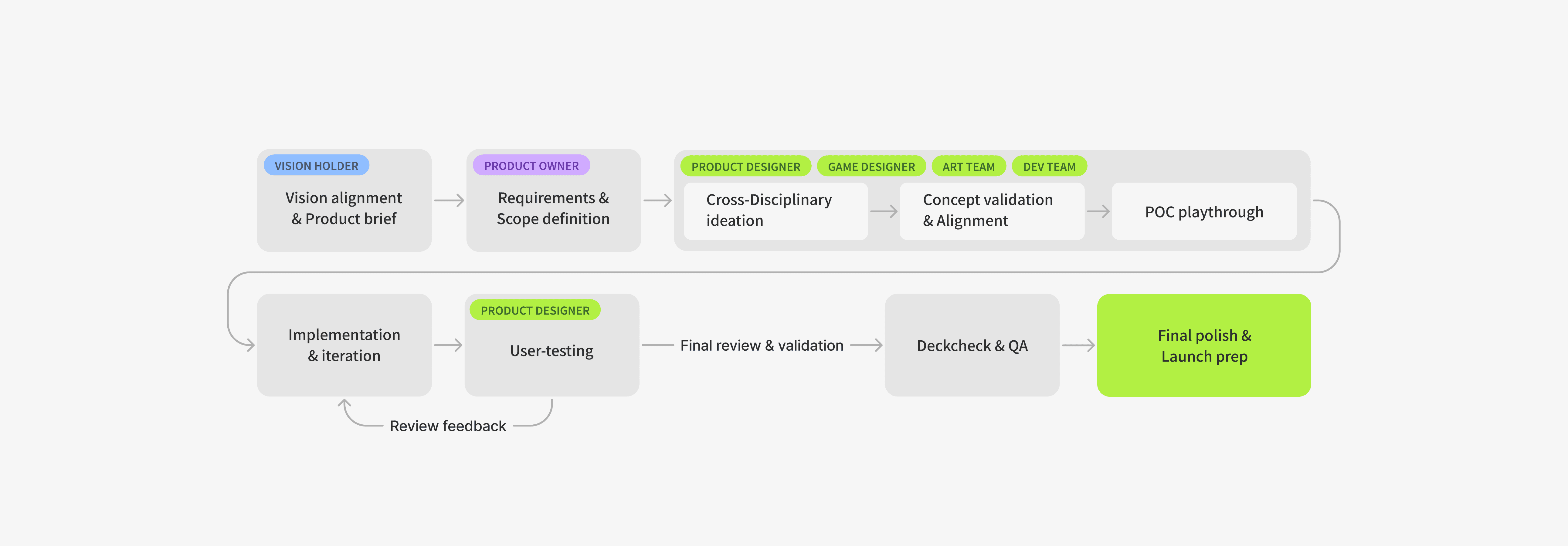
Product pipeline
As a Product Design Lead on Radiant, I've had the opportunity to work within a structured, cross-functional pipeline that not only challenged my design thinking but also sharpened my collaborative and leadership skills. Our workflow begins with a clear alignment of vision and goals with the product's key stakeholders, moving into detailed scoping and requirement gathering led by the Product Owner.
From there, I play a critical role in driving cross-disciplinary ideation sessions, where I collaborate closely with game designers, the art team, and developers. This early stage is particularly rich in learning, as it allows me to understand how each discipline approaches problem-solving, and how to integrate those perspectives into coherent design strategies.
Throughout the process, I've grown more adept at cross-team planning—balancing design intent with technical feasibility, game mechanics, and visual consistency. Working with game designers taught me to think in systems and player feedback loops, while collaborating with the art team introduced me to pipelines for asset creation, moodboarding, and visual storytelling.
This alignment is further validated through concept reviews, playthroughs, and ongoing iterations. As we move into implementation, I lead user testing efforts to gather insights and refine our product before passing it through QA and final polish. The cyclical nature of feedback and iteration ensures that we remain user-centric while maintaining alignment across all teams. Ultimately, this pipeline has deepened my understanding of product development in multi-disciplinary environments and reinforced the importance of communication, empathy, and planning in delivering a cohesive experience.
Designing the Core Product
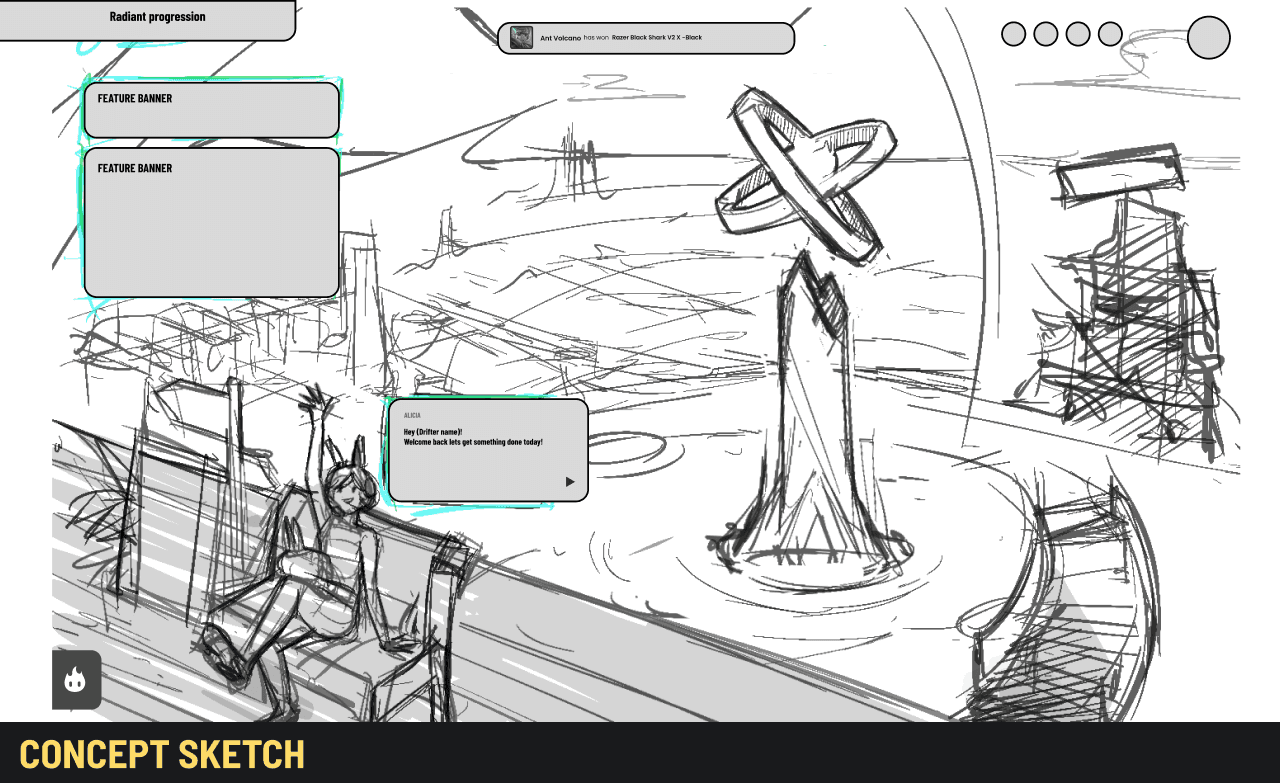
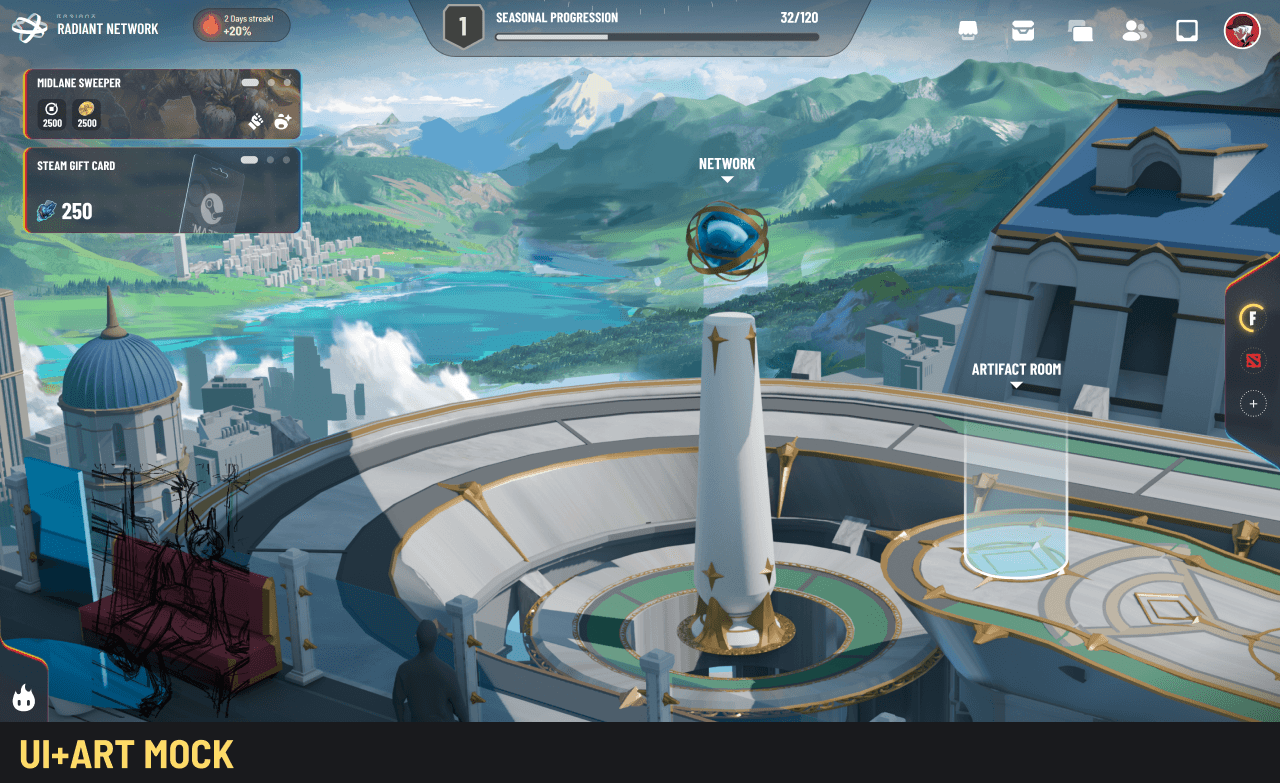
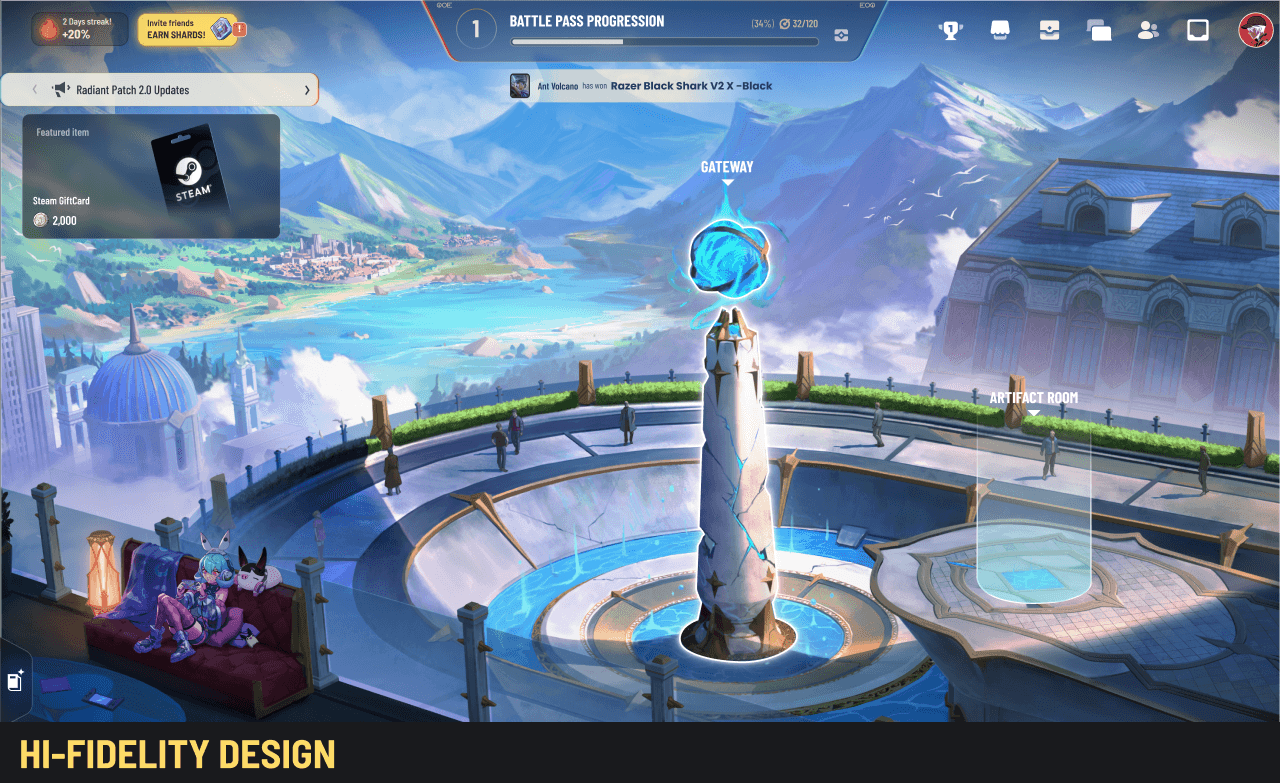
Beyond game mechanics, I had the opportunity to define Radiant's core product entities and lead the design system for the platform. This included establishing the brand identity and ensuring the user experience aligns with our gamified vision. The challenge was to craft an interface that feels intuitive for gamers while maintaining a service-oriented structure. This required balancing game-like UI/UX elements with functional design, ensuring Radiant remains both engaging and user-friendly.

Feature journey
I collaborated closely with the feature designer to design the user flow for the marketplace feature, focusing on creating a smooth and intuitive experience from start to finish. The flow begins with users discovering and browsing available items, using filters to narrow down their search. Once a product is selected, users can view more details, claim related quests, or move forward with a purchase. We incorporated key checkpoints such as login authentication and wallet connection to ensure security and personalization.
Throughout the process, validation feedback helps guide users through each step, reducing friction and potential confusion. The journey concludes with purchase confirmation and access to the user's inventory. This user flow was designed to clearly map out decision points while aligning with both user needs and technical requirements, ultimately delivering a streamlined e-commerce experience within the product.